
Tax Basis vs Trade Basis

Tax basis is your adjusted cost of a security, be it a stock, option or bond. Basically, tax basis is the cost of the security.
However, your cost can be "adjusted" based on a few nuances associated with trading options. Essentially, the cost basis or the proceeds can be adjusted based on whether your are long or short a put or call.
The following table reflects specific treatment by option type:

For this purpose, we will focus on Short Put assignment and not Short Call exercise.
The following table illustrates two purchase scenarios for NVDA stock, (1) the outright purchase of the stock and (2) the sale of a put and the assignment of the shares given that the stock price has dropped below the strike price at expiration.
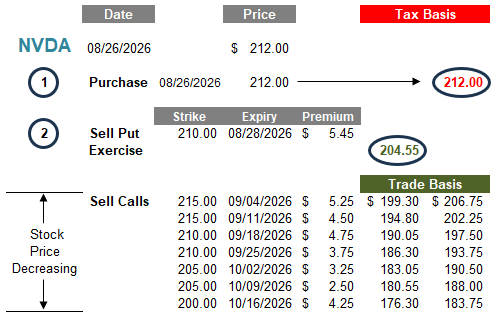
Under Scenario (1), the tax basis is the purchase price or, $212.00, whereas under Scenario (2) the tax basis includes the strike price ($210.00) the premium received for the sale of the put ($5.45) or, $204.55. So, if the stock settles at $208.00 after the close on the day of expiration, under scenario (1) you are sitting at a loss, whereas under scenario (2) you have a $3.45 gain right out of the blocks.
From a tax perspective, that is it, there are no further adjustments to basis.
However, and this is the way I choose to trade, by keeping track of subsequent short call premiums received in a covered call strategy, my "trading basis is shown in either of the two columns under the "Trade Basis" heading which helps me set my next strike so that overall, I will not sustain a loss. But, on my tax return, the subsequent short calls are shown as individual line items on Form 8949 or Form 4797 (as a mark to market trader) and the true tax basis is only based on how the stock was purchased, outright [scenario (1)] or through short put assignment [scenario (2)].
Correspondingly, if a long call is exercised, the tax basis is the strike price of the stock PLUS the premium paid for the long call.
Hopefully this helps understand the various aspects of stock basis when trading options and provides a tip for managing strike placement for subsequent short calls!!

Comments